 English
 français
 Deutsch
 Español
 italiano
 русский
 português
 tiếng việt
 Türkçe
 Polska
 Indonesia

E-mail:
info@rsgbottle.com
EN

Walk into any liquor store and grab a bottle of whiskey. You might notice something interesting: some bottles say 750ml, others say 700ml. That 50ml difference – is it really a big deal? If you're thinking about launching your own whiskey brand, trust me, this is way more than just "one less drink."
These two sizes come with their own histories, market logic, and customer expectations. Pick the right one, and your brand has a smoother ride. Pick wrong, and you might get ignored on the shelf. Let's break down this whole 750ml vs 700ml whiskey bottle thing so you can make a smart call.
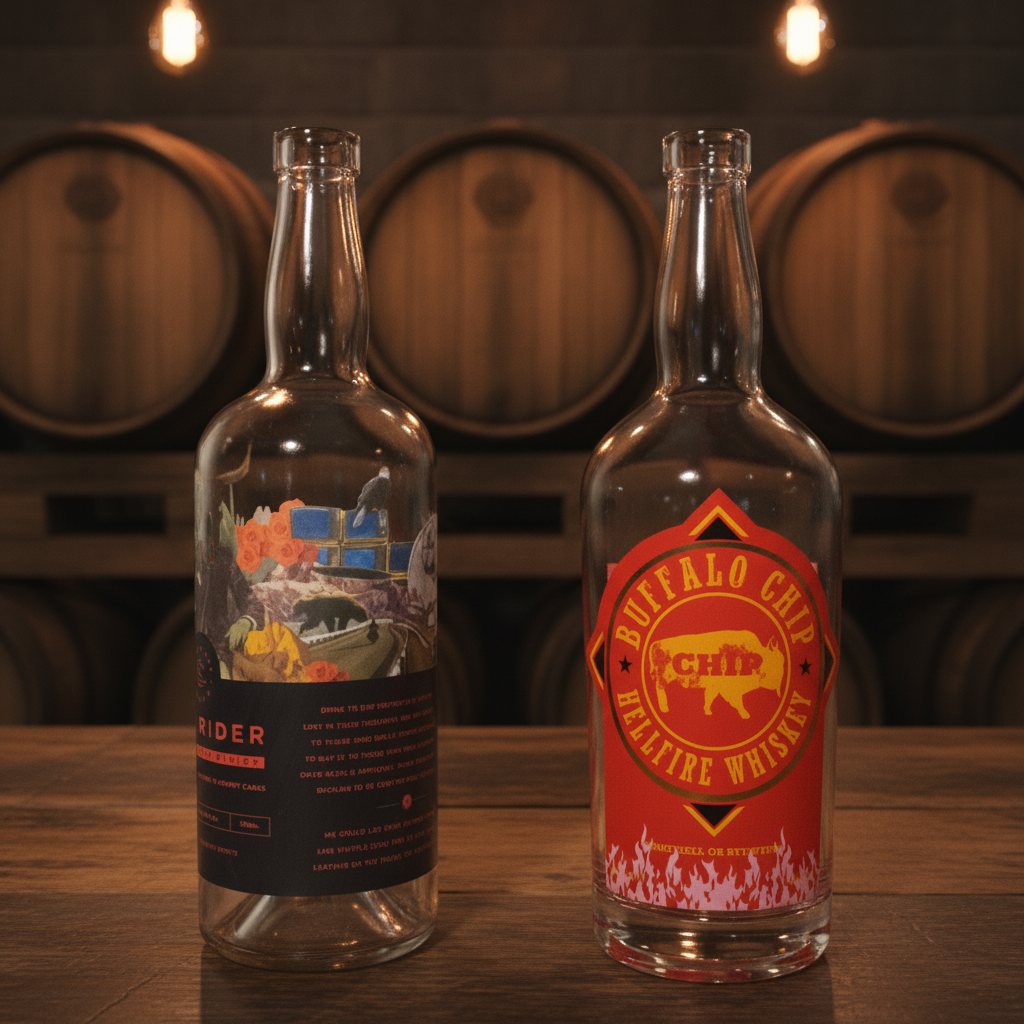
Let's do the math. 750ml is about 25.4 US fluid ounces. 700ml is about 23.7 US fluid ounces. Using the standard "one and a half ounce" pour, a 750ml bottle gives you roughly 16 to 17 drinks. A 700ml bottle gives you about 15 to 16. That's about one drink's worth of difference – 50ml.
But don't brush it off. Those 50ml represent totally different market logics.
In the US, the 750ml whiskey bottle has a special nickname: the"fifth."The name goes way back – it's exactly one fifth of a gallon. Back in the 1970s, the US liquor industry voluntarily switched to metric measurements. To keep things close to the old imperial sizes, they landed on 750ml as the standard.
Today, whether you're in a fancy New York bar or a small shop outside Chicago, 750ml is what customers see as a "normal whiskey bottle." If you're only selling in the US, 750ml is the safe, no-brainer choice. Consumers see that number and automatically have a price reference in their heads.
Europe took a different road. In 1993, after the EU was formed, new regulations set 700ml as the standard for spirits. Before that, Europe also used 750ml. So why the switch? Partly to unify the metric system and make cross-border trade easier. But let's be real – everyone also knew that keeping the price the same while shrinking the bottle meant a higher price per milliliter.
That said, 700ml actually has wider global reach than 750ml. The EU, UK, Asia, Australia – these major markets all recognize 700ml. You could call it the "international passport."
First, where are you selling? This is the biggest factor. Focused on the US market? Go with 750ml. Focused on Europe, Asia, or Australia? 700ml is the better fit. Want to do both? Then you're looking at dual SKUs – basically running two bottle lines.
Second, what story do you want to tell?750ml feels traditional, solid, American. 700ml feels a bit more refined, European, global. Your brand positioning will show up in that number on the bottle.
Third, think about costs.700ml uses about 7% less glass and less liquid per bottle. That adds up in raw materials and shipping. If your brand is cost-sensitive or you're doing big export volumes, this difference is worth a serious look.
Fourth, know the new US rules.At the end of 2020, the US TTB (Alcohol and Tobacco Tax and Trade Bureau) did something big – they updated the long‑standing rules on liquor bottle sizes andofficially added 700ml to the approved list. They also added 720ml, 900ml, 1.8L, and others. That old rule that said "the US only takes 750ml" is gone. This means some small Scottish whiskey brands that stayed out of the US market because of the 750ml requirement can now come in easily.
Fifth, watch the market trends.Lately there's a clear move towardboth smaller and larger bottles. On one hand, a lot of whiskey drinkers see 700ml as their everyday pour. On the other hand, smaller sizes like 200ml and 375ml are growing fast too.
Here's something people in the industry actually do. Some US whiskey brands, when exporting to Europe, just grab their existing 750ml bottles and fill them with 700ml of whiskey. No need for a new mold. Costs stay under control. And they can hit the European market fast. The only thing – it's probably a good idea to note this on the label somewhere. Don't let customers feel like they're getting shortchanged. Honesty goes a long way.
Before you decide, ask yourself a few questions:
· Where's your main market? The US or everywhere else?
· Is your brand traditional American or more international?
· How tight is your cost control?
· Long term, do you plan to expand into multiple markets?
· If your answer is"mostly the US,"750ml is the easiest road. Your target market has its own set of unwritten rules. If you don't play by them, you'll have to spend extra energy explaining why your bottle looks different.
· If your answer is"going international, or building a global brand,"700ml actually works better for you. It's more flexible across markets, shipping costs are a bit lower, and now that the US TTB rule has changed, selling 700ml in America isn't a problem anymore.
· And if you really do want to cover both markets, here's a practical suggestion:plan for dual SKUs from the start.Keep the bottle shape, closure system, and label style similar across the two sizes. That keeps your brand looking consistent and saves money compared to redesigning everything later.

· Bottom line
· Between 750ml and 700ml, the difference is way more than 50ml of whiskey. It's about how customers see your brand, your costs, and your long-term strategy. Pick the right bottle, and you're off to a good start. Pick wrong, and you might be at a disadvantage from day one. Take the time to understand your target customers and sales channels. Then make the call that fits your brand best.