 English
 français
 Deutsch
 Español
 italiano
 русский
 português
 tiếng việt
 Türkçe
 Polska
 Indonesia
E-mail:
info@rsgbottle.com
EN

What Even Happens Inside a Square Bottle Mold?
Picture this. You're a blob of molten glass. You're hot—like, "surface of the sun" hot—and you've just been dropped into a metal mold that wants you to become a fancy bottle.
If that mold is round? No problem, my friend. You just spread out evenly in every direction like pancake batter on a perfect griddle. Life is good. Everyone's happy.
But if that mold is square? Oh, you poor, confused glass blob.
Suddenly you have to make decisions. Do I go left? Right? Straight into that terrifying corner over there? And while you're deciding, you're also cooling down. Getting thicker. Losing your will to flow. By the time you finally commit to reaching that corner, you're basically crawling across the finish line like you ran a marathon you didn't train for.
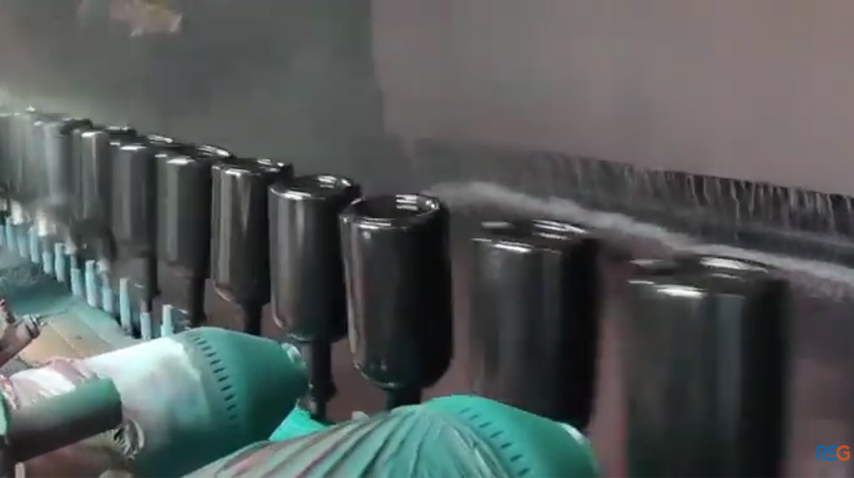
This is what glass nerds call "corner starvation." Dramatic name, simple problem: the corners end up thinner than the sides, and thin corners mean broken bottles..png "3.18_(2).png")
Unless you enjoy mopping up expensive bourbon from your kitchen floor, you should care a lot.
Those skinny corners are the first thing to shatter when a bottle tips over at a party. And if you're a premium spirits brand, a broken bottle isn't just lost product—it's your reputation exploding all over someone's hardwood floors.
Plus, thin corners look weird. Light behaves differently when it passes through less glass, so your supposedly "premium" square bottle ends up with dark, sad corners that scream "we couldn't quite figure this out."
Not a great look when you're charging $80 a bottle.
Want to know what actually happens inside a factory that makes these things right?
Let me introduce you to some people you'll never meet but whose existence determines whether your favorite whiskey's bottle has corners you can trust.
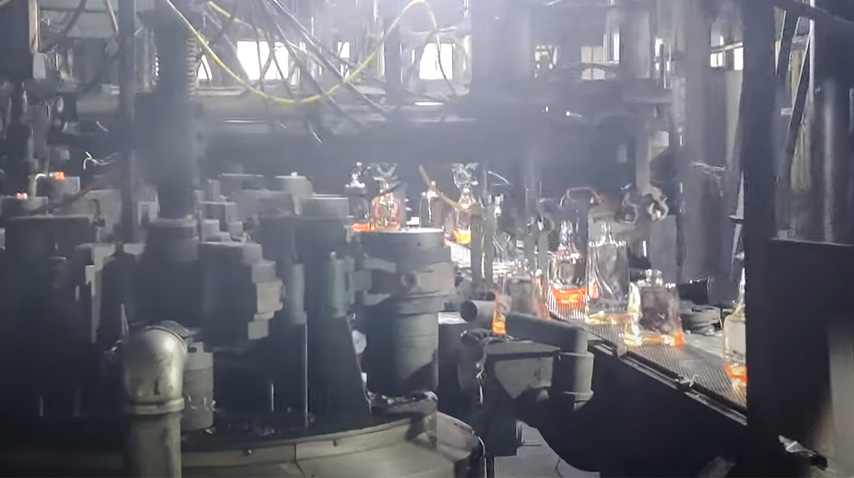
Meet Pedro. He's been watching glass fall for nineteen years.
It's 2:47 AM. Pedro's standing in front of a machine that drops molten glass into molds. He's counting under his breath—3.8 seconds, that's the magic number. The glass needs to settle into the corners in exactly 3.8 seconds. Not 3.7. Not 4.0. 3.8.
Every drop, he leans forward slightly, like he's willing the glass to land right. His neck muscles are tight. He's been doing this since before some of his coworkers were born.
Upstairs, there's Mira. She's been staring at a computer screen for six hours.
Mira designs molds. Tonight she's running simulations of virtual glass flowing into virtual corners. On her screen, red particles move fast (good), blue particles have given up and stopped moving (bad). The blue ones cluster in the corners like people avoiding conversation at a party.
Her coffee cup says "WORLD'S OKAYEST MOLD DESIGNER." She's on her fourth refill.
And at the end of the line, there's Maria. She has what her husband calls "the curse."
Maria has been inspecting square bottles for eleven years. She can spot a thickness variation from twenty feet away, which means she also notices when restaurant glasses are lopsided and when store windows have weird distortions. Dining out with her is exhausting.
Every tenth bottle, she pulls it off the line and measures the corners with calipers that have worn smooth spots from her grip. She writes numbers on a clipboard covered in coffee rings.
These three people have never had lunch together. They probably couldn't pick each other out of a lineup. But together, they're why the square bottle on your shelf doesn't explode when you look at it wrong.
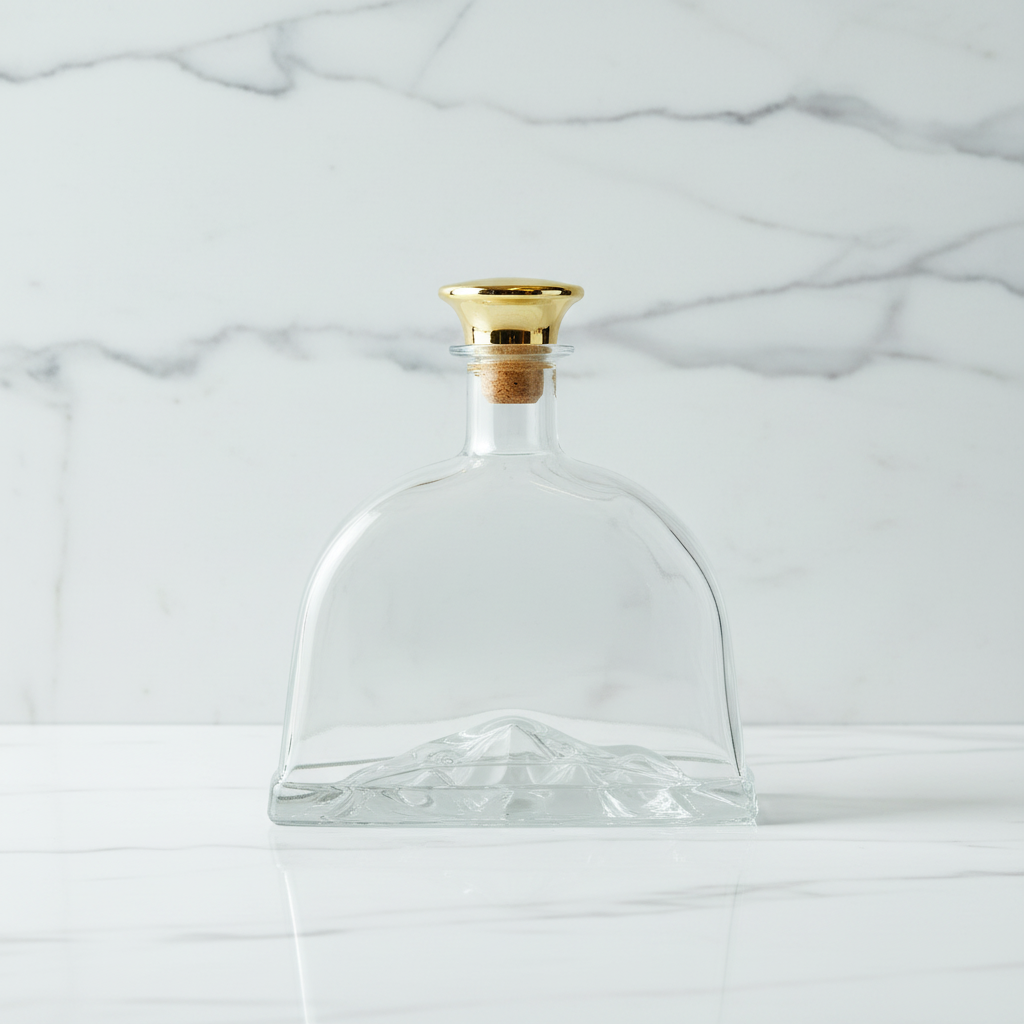
This is where the real pros separate themselves from the amateurs. Making good square bottles takes three things: smarter molds, obsessive control, and people who've broken enough bottles to know better.
First, the molds have to be designed by someone who's been burned before.
Companies like RSG Glass don't guess at this stuff. They simulate how glass will flow before they ever cut metal for a mold. They position cooling channels exactly where they need to be—not too much, not too little—so the corners stay warm enough to fill completely but cool fast enough to keep the line moving.
It's like conducting an orchestra where every musician is made of molten sand and hates you personally.
Then you have to control literally everything.
Temperature has to be perfect—a few degrees off and your corners go from "flawless" to "garbage." The timing of when you press the glass, how hard you press it, how you cool different parts of the mold... it's all connected. Change one thing, and everything else shifts.
At 3 AM on Pedro's shift, the supervisor walks over with bad news: one cavity's corners have thinned by two-tenths of a millimeter over the last thirty bottles.
Pedro doesn't panic. He walks to a control panel that looks like something from a submarine movie and makes an adjustment so small his fingers barely move. He adds twelve milliseconds to the settle time. Twelve milliseconds. That's his fix.
They watch the monitors. The corners start coming back.
And finally, you inspect every single bottle like your life depends on it.
Maria doesn't trust the automated inspection machines completely. She pulls bottles randomly, measures them by hand, writes down numbers that will live forever in a database somewhere.
At 4:47 AM, a bottle comes through that's slightly off. Nobody else would notice. Pedro catches it before it's even fully formed. By the time it reaches Maria, the reject arm is waiting.
THWIP. The bottle gets kicked into a bin of broken glass, where it will be melted down and tried again. Its entire existence lasted less than a minute.
During his break, Pedro fishes it out of the bin. He holds it up to the light. There it is—the corner he knew would be thin. A spot where the glass is just a shade darker. To anyone else, it's a perfectly fine bottle. To Pedro, it's a confession.
"You almost fooled me," he tells it, and drops it back with the other failures.
Let's be honest. Round bottles are the sensible friend your parents want you to date. Square bottles are the mysterious stranger with the motorcycle.
Round bottles give you glass that flows where it should, like a well-behaved child. Square bottles give you glass that fights you every step of the way. Round bottles offer predictable strength. Square bottles let corners determine everything. Round bottles have meh stacking efficiency. Square bottles deliver maximum shelf space usage. Round bottles put your labels on curved surfaces. Square bottles give you flat surfaces for maximum branding impact.
See? Square bottles are high-maintenance. But when they're done right, they're worth every headache.
At 6 AM, Pedro clocks out and walks into the sunrise. Behind him, the line keeps running.
On his way out, he passes the day's first "beauty box"—a dozen perfect square bottles destined for a client meeting in Manhattan. They're flawless. Corners so consistent you could measure them with a microscope. Glass so clear it's almost invisible.
He picks one up. Turns it in the gray morning light.
Somewhere in Kentucky, a master distiller will sign off on this bottle. A marketing team will photograph it for ads. A collector will buy it and set it on a shelf.
None of them will ever know that at 2:47 AM on a Tuesday, a guy with a sore neck added twelve milliseconds to a machine setting so this corner—right here—would be thick enough to survive.
RSG Glass has been making square bottles through nights just like this one for over twenty years. They've got the people who count under their breath at 3 AM. They've got the mold designers who stare at simulations until their eyes cross. They've got the inspectors who can spot a bad corner from across the room.
And when your brand needs square bottles that actually work—bottles with corners you can trust, glass clear enough to show off what's inside, quality that passes inspection in over fifty countries—they're the ones who've already figured out how to make them.
Because at the end of the day, nobody remembers the round bottle that worked fine. But everyone remembers the square bottle that looked incredible and never broke.
Well, they remember the broken one too. But for all the wrong reasons.
Want square bottles with corners that actually cooperate? RSG Glass has been figuring this out since before square was cool. Your future bottles—and the people who have to inspect them at 4 AM—will thank you.